Is 2027 a Leap Year: Rules, Next Leap Years & Full List 2000-2100
Table of Contents (10 sections)
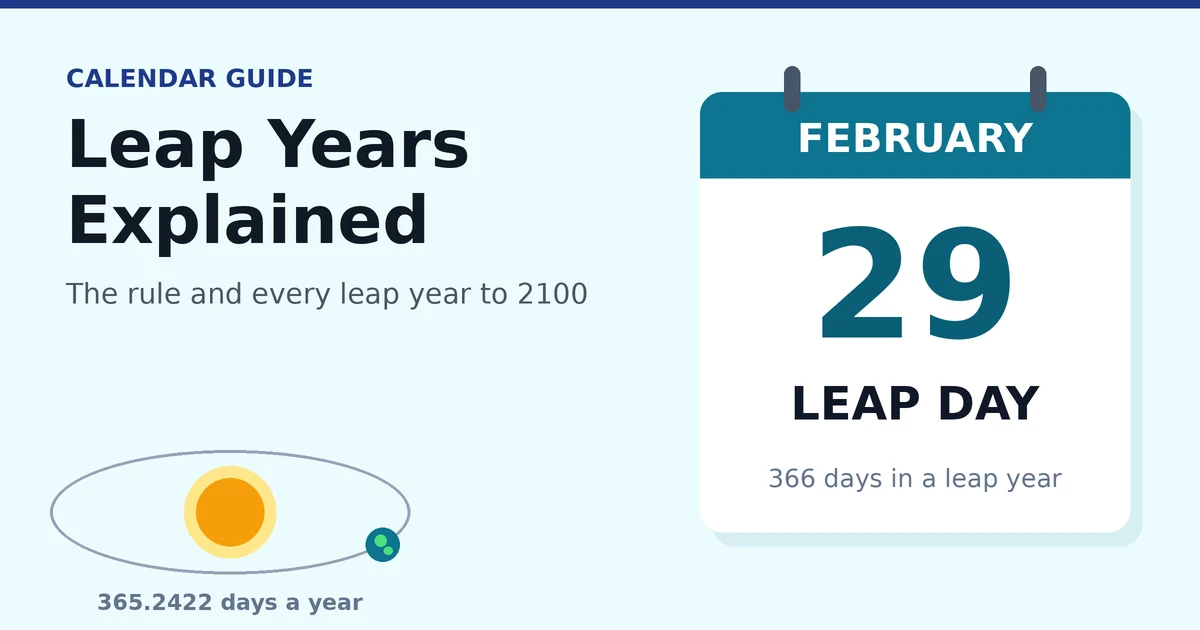
A leap year adds one extra day, February 29, to keep the calendar in step with the seasons. Most people know it happens every four years. Fewer know the exceptions, which is why 2000 was a leap year but 1900 was not, and 2100 will not be one either. Here is the quick answer, the full rule and a list of leap years up to 2100.
Is 2027 a leap year? No.
2027 is not a leap year. It has 365 days, and February has 28 days.
The next leap year is 2028, with February 29 on a Tuesday. The one after that is 2032.
Quick summary
- The rule: a year is a leap year if it can be divided by 4, except century years, which must be divisible by 400.
- Leap day: February 29. A leap year has 366 days instead of 365.
- Next leap years: 2028, 2032, 2036 and 2040.
- Why: the Earth takes about 365.2422 days to go around the Sun, almost a quarter of a day more than 365.
- Exceptions: 1900 was not a leap year, 2000 was, and 2100 will not be.
The Leap Year Rule in Three Steps
The calendar we use, the Gregorian calendar, decides leap years with three simple checks:
- If the year can be divided by 4, it is a leap year. Example: 2024 and 2028.
- But if the year can also be divided by 100, it is not a leap year. Example: 1900 and 2100.
- Unless the year can also be divided by 400. Then it is a leap year after all. Example: 1600 and 2000.
So for almost any year you will plan around, the first step is all you need: if it divides evenly by 4, it is a leap year. The exceptions only matter at the turn of a century, and the next one is 2100.
Quick Answers for the Next Few Years
- 2026 is not a leap year. It has 365 days, and February has 28 days.
- 2027 is not a leap year. It has 365 days, and February has 28 days.
- 2028 is a leap year. It has 366 days, and February has 29 days.
- 2029 is not a leap year. It has 365 days, and February has 28 days.
Leap Years from 2000 to 2100
Every leap year from 2000 to 2100, with the day of the week February 29 falls on. Note that 2100 is skipped.
| Year | February 29 falls on |
|---|---|
| 2000 | Tuesday (past) |
| 2004 | Sunday (past) |
| 2008 | Friday (past) |
| 2012 | Wednesday (past) |
| 2016 | Monday (past) |
| 2020 | Saturday (past) |
| 2024 | Thursday (past) |
| 2028 | Tuesday (next leap day) |
| 2032 | Sunday |
| 2036 | Friday |
| 2040 | Wednesday |
| 2044 | Monday |
| 2048 | Saturday |
| 2052 | Thursday |
| 2056 | Tuesday |
| 2060 | Sunday |
| 2064 | Friday |
| 2068 | Wednesday |
| 2072 | Monday |
| 2076 | Saturday |
| 2080 | Thursday |
| 2084 | Tuesday |
| 2088 | Sunday |
| 2092 | Friday |
| 2096 | Wednesday |
| 2100 | Not a leap year (divisible by 100 but not by 400) |
Why Do We Have Leap Years?
A calendar year has 365 days, but the Earth takes about 365.2422 days to complete one trip around the Sun, measured from one spring equinox to the next. That leftover is almost six hours a year.
Six hours does not sound like much, but it adds up to about one full day every four years. Without leap days, the calendar would slip by about 24 days every century, and over a few hundred years the seasons would drift into the wrong months. Adding February 29 in most fourth years pulls the calendar back in line.
Why Is Every Fourth Year Not Enough?
An extra day every four years makes the average year 365.25 days long. That is about 11 minutes longer than the real year, and those 11 minutes slowly add up the other way.
The Julian Calendar
The Roman leader Julius Caesar introduced a calendar in 46 BC with a leap day every four years and no exceptions. It worked well for centuries, but the extra 11 minutes a year added up. By 1582, the spring equinox was arriving about 10 days earlier on the calendar than it did in AD 325, when church leaders agreed on how to set the date of Easter. Because Easter is tied to the spring equinox, the drift was a real problem. Our guide to when Easter falls explains that rule.
The Gregorian Fix of 1582
In 1582, Pope Gregory XIII introduced the calendar we use today. It did two things:
- Dropped 10 days at once: Thursday, October 4, 1582 was followed by Friday, October 15.
- Changed the leap year rule: century years became leap years only if they divide by 400. That removes three leap days every 400 years and makes the average year 365.2425 days, very close to the real 365.2422.
The new calendar is off by only about one day in more than 3,000 years.
When America Switched
Not every country changed in 1582. Britain and its American colonies kept the old calendar until 1752. By then they were 11 days behind, so people went to bed on Wednesday, September 2, 1752 and woke up on Thursday, September 14. The same change moved New Year's Day from March 25 to January 1. That is why George Washington's birth date, February 11, 1731 under the old calendar, is written today as February 22, 1732. Our Presidents' Day guide tells that story.
Leap Day Facts
- Chances of a leap day birthday: about 1 in 1,461, because February 29 comes once in every 1,461 days.
- 366 days: a leap year has 52 weeks and 2 days, so two days of the week appear 53 times that year instead of one.
- Weekday jumps: a date usually moves one weekday from one year to the next. When February 29 comes in between, it moves two. For example, July 4 is a Sunday in 2027 and a Tuesday in 2028.
- Calendars that repeat: the 2028 calendar is exactly the same as 2000 and 2056, because those leap years also start on a Saturday. Between 1901 and 2099, a leap year calendar repeats every 28 years.
- Leap day birthdays: people born on February 29 usually celebrate on February 28 or March 1 in other years.
See February 29 on a Calendar
The 2028 calendar already includes February 29, so every date after it falls on the right weekday. The February 2028 calendar shows the extra day. For any other month, use our printable monthly calendar.
Frequently Asked Questions
Is 2026 a leap year?
2026 is not a leap year. It has 365 days, and February has 28 days.
Is 2027 a leap year?
2027 is not a leap year. It has 365 days, and February has 28 days.
When is the next leap year?
The next leap year is 2028. February 29, 2028 falls on a Tuesday. The leap year after that is 2032.
How do you know if a year is a leap year?
It is a leap year if it can be divided by 4, unless it can be divided by 100. Years that can be divided by 400 are leap years after all.
Why was 2000 a leap year but 1900 was not?
Both are century years, which are leap years only if they divide by 400. 2000 divides by 400, so it was a leap year. 1900 does not, so it was not.
Is 2100 a leap year?
No. 2100 can be divided by 100 but not by 400, so it will be a normal year with 365 days.
How many days are in a leap year?
366 days. The extra day is February 29.
What are the chances of being born on February 29?
About 1 in 1,461, because February 29 comes once in every 1,461 days, or once every four years.